
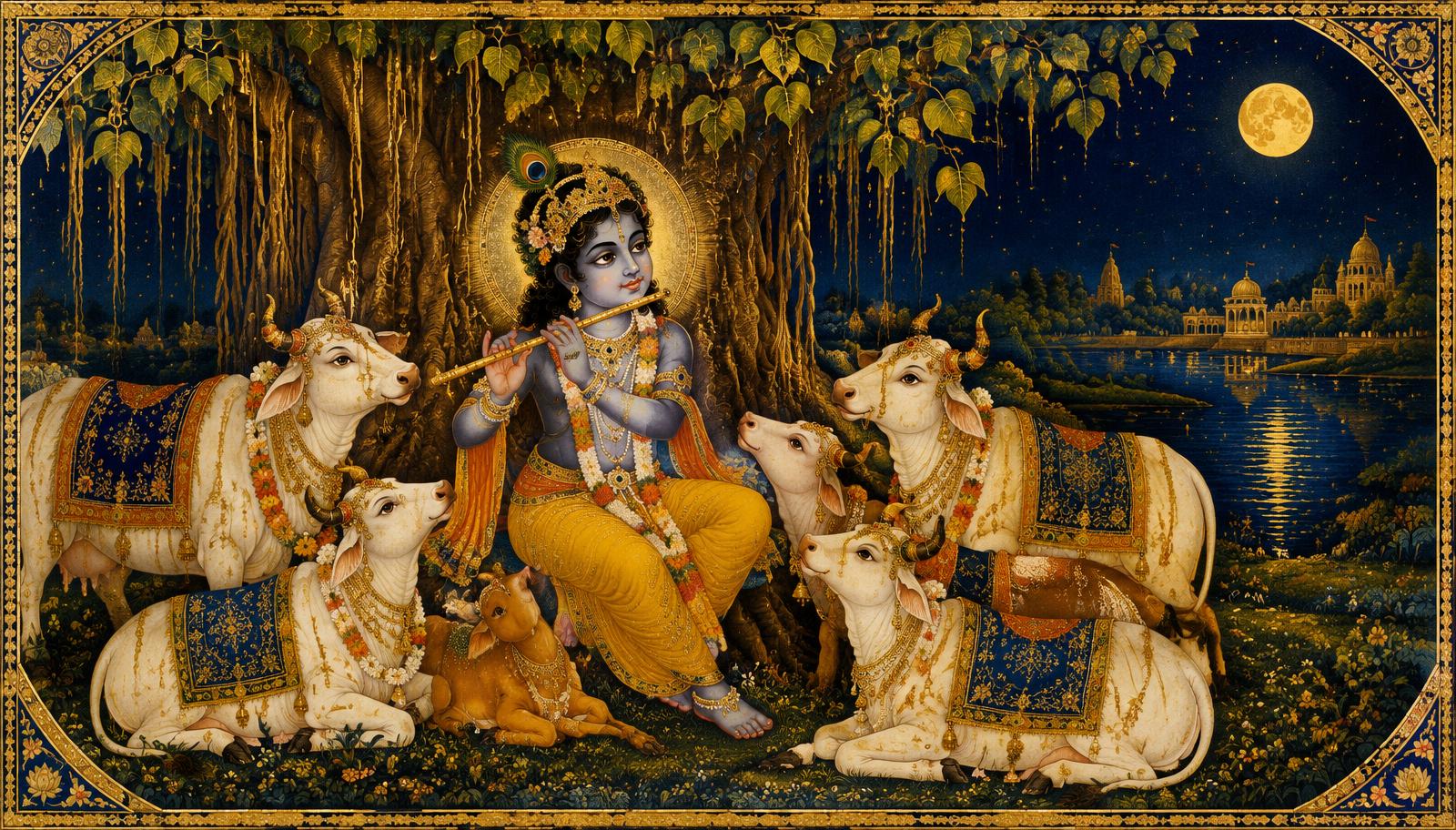
Classical painting of Krishna playing the flute among decorated cows at night

Krishna & Yadav heritage

Krishna — the cowherd of Gokul, the king of Dwarka

Krishna is among the most widely revered figures in Indian tradition, and his story is inseparable from the Yadava lineage and a pastoral, cattle-keeping way of life. This page retells the full narrative as it appears in classical texts and devotional tradition, and explains where it connects to Yadav heritage.

Traditional accountClassical sourcesLiving tradition

Watch

The story in five scenes

A cinematic retelling of the traditional account — the birth in Mathura, the cowherd childhood of Gokul, the lifting of Govardhan, the Yadava capital of Dwarka, and the Bhagavad Gita at Kurukshetra. Artistic depiction, not documentary footage.

How to read this page. Krishna's life is known through scripture and devotional literature — principally the Harivamsa, the Bhagavata Purana, the Vishnu Purana and the Mahabharata. These texts present him in different registers: as a divine figure, a heroic ancestor and a teacher. The narrative below is retold here as traditional account, respectfully and without claiming it as documented history. The section at the end discusses what historians say about the texts themselves.

The story — part one

Birth in a prison, rescue across a river

The narrative begins in Mathura, a city on the Yamuna river ruled by King Kamsa. A divine prophecy warns Kamsa that a child born to his cousin Devaki and her husband Vasudeva will end his rule. Kamsa imprisons the couple and destroys their children one by one.

When their eighth child is born at midnight, tradition holds that the prison doors open by themselves and Vasudeva carries the infant across the flooded Yamuna to the village of Gokul, exchanging him with the newborn daughter of Yashoda. The child grows up as the son of Yashoda and her husband Nanda — the head of a cowherd settlement.

The story — part two

Childhood among the cowherds of Gokul and Vrindavan

This is the Krishna most beloved in popular memory: a mischievous child who steals butter, a boy who lifts the Govardhan hill on one finger to shelter his village from a storm sent by Indra, and a young man whose flute-playing draws the whole settlement to the banks of the Yamuna. He dances with the gopis, tames the serpent Kaliya in the river, and grows up herding cattle alongside his brother Balarama and the other boys of the village.

The setting matters: these stories are rooted in the daily rhythms of pastoral life — cattle camps, milk and butter, grazing grounds, monsoon rivers and village festivals. It is this cowherd world, the texts say, that Krishna never leaves behind, even as a king.

The story — part three

Kamsa's fall and the return to Mathura

Years later Kamsa learns the child he sought is alive and lures Krishna to Mathura through a wrestling festival. There Krishna kills the royal elephant's keeper's champion wrestler and finally Kamsa himself, freeing his parents and restoring the captive families. He crowns Kamsa's father Ugrasena king again and stays in Mathura to study and train.

When Jarasandha, Kamsa's father-in-law, repeatedly attacks Mathura in revenge, tradition describes a strategic decision: rather than defend an exposed city, Krishna leads his people to safety and builds a new capital.

The story — part four

Dwarka and the Yadava kingdom

That new capital is Dwarka, on the western coast in present-day Gujarat — described in the texts as a fortified city built on land reclaimed from the sea. Here Krishna is said to have ruled alongside the Yadavas, the extended clan descended from the ancient king Yadu. He marries Rukmini and others, befriends Arjuna, and his sister Subhadra marries Arjuna in one of the Mahabharata's best-known episodes.

The Mahabharata gives the Yadavas a large role in its political story: Krishna's diplomacy, his council to the Pandavas, and the shifting alliances of the northern kingdoms all pass through the Yadava court.

The story — part five

The Bhagavad Gita at Kurukshetra

On the first day of the great war between the Pandavas and the Kauravas, Arjuna refuses to fight, unable to accept killing his own relatives. Krishna, serving as his charioteer, responds with the discourse known as the Bhagavad Gita — a dialogue on duty, action, devotion and the self that has become one of the most read works in world literature. Its central teaching is often summarised as: do your duty sincerely, without attachment to its fruits.

Krishna also serves the Pandavas as counsellor and diplomat before and during the war, famously taking the side of dharma while refusing to take up arms himself. The war ends in victory for the Pandavas at devastating cost.

The story — part six

The end of an era

The texts close Krishna's story with sorrow. The Bhagavata Purana and the Mahabharata's Mausala Parva describe how the Yadavas, grown proud, destroy themselves in a quarrel at Prabhasa, and how Dwarka is swallowed by the sea. Krishna withdraws to a forest and dies from a hunter's arrow, an ending the texts present as the closing of the Dvapara age and the beginning of the present age, the Kali Yuga. The episode is read by commentators as a caution about pride and internal division — a message about unity that communities recounting this heritage have often taken to heart.

The connection

Why Krishna holds a special place in Yadav heritage

A shared lineage story

In the Puranic genealogies, Krishna is born into the Yadu-vamsha — the lineage of King Yadu — and the people of Gokul, the Ahirs and cowherd clans among them, are portrayed as his own community. Many families across the wide group of communities today known as Yadav, including Ahir, Gopal, Goala, Gwala, Konar, Kuruba, Idaiyan and related pastoral groups, treasure this story as their origin narrative. It is the single most important reason the name "Yadav" is used as a shared identity today.

Important qualification: this is a traditional and devotional account. Historians treat Puranic genealogies as literary and social documents, not family registers, and the historical links between ancient texts and modern communities are a matter of study and debate. Honouring the story and documenting history are kept separate on this site.

A pastoral identity

Krishna's cowherd life mirrors the livelihoods at the heart of Yadav heritage: care of cattle, dairying, and village festivals built around the seasons. Festivals such as Janmashtami, Govardhan Puja and Gopashtami, celebrated by millions, carry special meaning in households that see their own ancestors' way of life reflected in them. Many community institutions, dairies and cooperatives are named after Krishna or Govardhan for this reason.

Values, not just ancestry

Community writing about Krishna typically emphasises his example as much as his lineage: humility in friendship, courage against injustice, loyalty to one's people, care for animals, and the Gita's teaching to act well without arrogance. These are the values this portal's educational work highlights, in an inclusive spirit — Krishna is revered by hundreds of millions of people of many communities, and nothing on this page is claimed to the exclusion of anyone else.

Scholarly view

What historians say about the sources

Scholars study Krishna on several levels. The Harivamsa, Vishnu Purana and Bhagavata Purana were composed over centuries, with the oldest layers generally dated to the first millennium CE, and they preserve older oral and regional traditions in a later literary form. Devotion to Krishna as a deity is well attested by the early centuries CE, and by the medieval period it was a pan-Indian phenomenon with regional literary traditions from Tamil Alvar hymns to Braj poetry.

Archaeologists have explored sites in the Dwarka region, and underwater investigations there have drawn both interest and methodological debate; no finding is accepted as confirming the narrative events. Historians also study how pastoral communities across India have adopted and retold these stories as part of social identity, especially from the late nineteenth century onward. Presenting the tradition and the scholarship side by side, without forcing either into the other, is the approach taken throughout this site.

Further reading

Where this story comes from

Classical texts (traditional account)

  • Harivamsa — the earliest full narrative of Krishna's life and the Yadava lineage
  • Bhagavata Purana — the devotional classic covering Gokul, Vrindavan and Dwarka
  • Vishnu Purana and the Mahabharata, including the Bhagavad Gita and the Mausala Parva
  • Regional devotional literature, from Alvar hymns to medieval Braj and vernacular poetry

Scholarship (historical study)

  • Published academic studies of Krishna devotion and Vaishnava traditions
  • Scholarly literature on the Puranas as historical and literary sources
  • Studies of pastoral communities and identity in South Asia
  • Published reports and debates on archaeological work in the Dwarka region

Yadav.help presents Krishna's story as living tradition, with respect and without political or sectarian claims. Debated points are labelled as such, and readers are encouraged to consult the full texts and the scholarship listed above.